Physical Address
304 North Cardinal St.
Dorchester Center, MA 02124
Physical Address
304 North Cardinal St.
Dorchester Center, MA 02124

Fairy rings are made by fungi spreading outward through the soil. Learn how they form, the three types you'll see in lawns, the "fairy chemicals" behind greener grass, and why ring mushrooms aren't safe to eat without expert ID.
One morning you look out at the lawn and there it is: a circle of mushrooms, or a ring of grass that’s greener than the rest. People once believed these circles were dance floors for fairies. Today we know they’re made by fungi, and the real explanation is almost as interesting as the folklore.
This guide explains how fairy rings form, the three types you might see in a lawn, which mushrooms are responsible, what to do about them, and why you should never assume the mushrooms in a ring are safe to eat.
BBC Wildlife Magazine defines a fairy ring as “a dark patch of grassy ground that produces a circle, or partial circle, of small mushrooms, usually in autumn.” Over the years the circles have also been called fairy courts, fairy walks, fairy grounds and hag tracks. According to the same article, people once believed the rings were dance floors for night-time fairies, with the mushrooms serving as seats.
Fairy rings can be small or very large. The Maine Department of Agriculture, Conservation and Forestry says they range “from a few inches to 200 feet in diameter.”
The mushrooms you see are only a small part of the fungus. Most of it lives underground as mycelium, a network of fine threads that spreads through the soil.
Mycologist Michael Kuo, writing on MushroomExpert.com, explains the basic pattern. When food in the soil is evenly spread, the mycelium grows outward in all directions from its starting point. If it produces mushrooms, they appear at the outer edge of the circle. BBC Wildlife compares this to apples on a tree: the mushrooms around the ring all belong to one organism.
Montana State University Extension puts it simply: the ring shape comes from “the natural radial growth pattern that fungi exhibit.” Each year the ring expands. University of Nevada Cooperative Extension says rings spread outward from a central point at roughly 1 to 2 feet a year, and can “grow right out of a small lawn.”
Because the ring keeps expanding, a bigger ring generally means an older fungus. Kuo notes that some studies, which assumed the ring grew evenly each year, estimated that the mycelium of large rings could be “hundreds of years old!” That figure depends on the assumption of steady growth, so treat it as an estimate rather than a measured age.
The Nevada fact sheet says the mycelium can reach 10 to 20 inches deep in loose soil, and pathologists have found it as deep as 4 feet. In clay soil, it may stay in the top 1 to 2 inches.
Lawns are among the most common places to see fairy rings. Kuo explains that lawns are maintained to be even, which gives the mycelium a consistent environment to spread through. In woodland, soil is less uniform, so complete rings are less common, although he has seen mushrooms such as Amanita and Russula fruiting in large arcs.
University of Nevada Cooperative Extension describes three types of fairy ring in lawns. You may see more than one effect in the same ring.
| Type | What you see | What causes it |
|---|---|---|
| Type I | Zones of dead grass, sometimes as two rings, often without mushrooms | Water-repellent fungal threads stop moisture reaching the roots, so the grass dies from drought |
| Type II | A ring of lush, dark green grass | Nitrogen released as the fungus breaks down organic matter |
| Type III | A ring of mushrooms, with no visible harm to the grass | The fungus fruiting at the edge of the ring |
As the fungus breaks down dead roots, thatch and buried wood, it releases nutrients. The Nevada fact sheet points to nitrogen, and says Type II rings are most visible in spring before regular fertilising, and more noticeable in lawns that are short of nitrogen. Montana State University Extension says the “darker color in the grass is caused by excess nutrients”. BBC Wildlife adds that the fungus “liberates nutrients in the soil, enabling the vegetation at the edge of the circle to grow taller.”
In Type I rings, the problem is water. The Nevada fact sheet explains that dense, water-repellent mycelium can stop water soaking into the soil, so the grass above suffers drought even when the lawn is watered. In arid and semi-arid regions, it says, the effect can last 12 to 18 months.
Fungi may affect grass in another way too. In a 2018 article for C&EN, published on the American Chemical Society’s Axial site, Louisa Dalton described the work of Hirokazu Kawagishi of Shizuoka University in Japan. Kawagishi noticed circles of darker, taller grass on his campus. Mushrooms appeared in the patches, and he isolated a growth-promoting molecule from the mushroom Lepista sordida.
The molecule is called 2-azahypoxanthine, or AHX. Kawagishi and colleagues named it and its close relatives “fairy chemicals”. According to the article:
A 2015 study by Asai and colleagues in Japan Agricultural Research Quarterly tested AHX on rice in pots and fields. It found that AHX improved brown rice yields, with panicle number and stem length tending to increase, while grain weight was not affected.
This research is still at an early stage. The C&EN article notes that it can take a long time for the agricultural industry to vet a new molecule, so don’t expect fairy chemicals on garden centre shelves soon.
Many different fungi can form rings. The Maine Department of Agriculture, Conservation and Forestry says about 50 to 60 species are known to form fairy rings in turf. Kuo goes further, suggesting that nearly any ground-dwelling mushroom can form a ring if the soil is even enough.
| Mushroom | Notes from our sources |
|---|---|
| Marasmius oreades, the fairy ring champignon | The most common cause of lawn fairy rings, according to the Nevada, Montana and BBC Wildlife sources. BBC Wildlife describes it as common on lawns and playing fields. |
| Agaricus species | Listed by the Maine DACF and by Kuo as fairy ring formers |
| Puffballs (Lycoperdon species) | Listed by the Maine DACF |
| Earthballs (Scleroderma species) | Listed by the Maine DACF |
| Chlorophyllum molybdites, the green-spored parasol | Forms rings in lawns, according to Kuo and the University of Florida. Poisonous. |
| Lepista sordida | The source of the “fairy chemical” AHX |
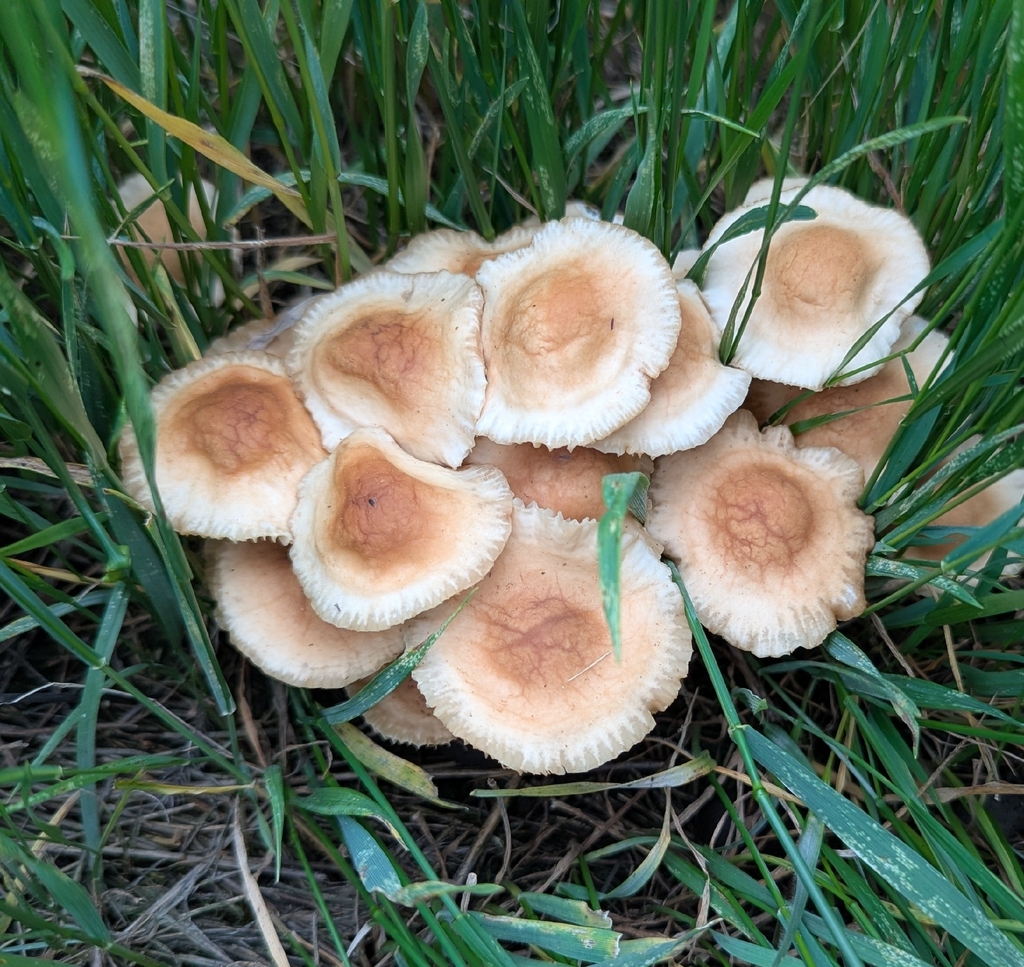
Our featured photo shows Marasmius oreades, the species field guides call “the fairy ring mushroom”. As Kuo points out, though, it “is not the only fairy ring mushroom.”
Don’t assume so. A ring can be formed by an edible species, a poisonous one, or one you’ve never heard of. University of Nevada Cooperative Extension warns that many ring-forming species produce mushrooms that “may be toxic to humans and especially toxic to small children and pets.”
One ring-former deserves special mention. The University of Florida describes Chlorophyllum molybdites, the green-spored parasol, as “the most common cause of mushroom poisoning in the United States”, citing a 1992 study. It “commonly creates a complete or incomplete ‘fairy ring'” in lawns and grassy areas.
According to the University of Florida fact sheet:
The safest approach is simple: don’t eat mushrooms from your lawn unless an experienced local expert has identified them. If a child or pet may have eaten one, contact a poison control centre or a vet straight away. Our guides to mushroom poisoning and poisonous mushrooms and dogs explain what to do. Photo apps can be a useful learning tool, but our review of mushroom identification apps explains why they shouldn’t decide what’s safe to eat.
Often, you don’t need to. Montana State University Extension says fairy rings are usually not harmful to lawns, and no control is needed if you can live with slight colour differences. BBC Wildlife calls the fairy ring champignon harmless, though a problem if you need perfect turf.
If a ring is causing dead patches, extension services suggest these options:
| Approach | What extension services say |
|---|---|
| Mask the ring | Fertilise the whole lawn so the rest greens up to match the ring (Nevada) |
| Mow, aerate and fertilise | Reduces differences in grass colour and health (Montana) |
| Water deeply | Keep the lawn from drying out and water to 6 to 8 inches deep (Nevada) |
| Break up the soil | Drilling, drenching or aerating can suppress the fungus, though it won’t eliminate it. Keeping the soil moist for 4 to 6 weeks helps (Nevada) |
| Remove and replace | Removing turf and repeatedly tilling the soil is effective, followed by reseeding (Nevada). Montana notes this is “not always effective” |
| Fungicides | Montana says they are “strongly discouraged because they are not very effective”. Nevada reports limited success |
The Nevada fact sheet suggests removing mushrooms by hand or by mowing as soon as they appear, especially where children or pets play. Wear gloves if you’re handling unknown mushrooms, and wash your hands afterwards. Removing the mushrooms won’t remove the fungus underground, so they’re likely to come back.
The Nevada fact sheet suggests keeping the lawn from drying out, following fertiliser rates, aerating in spring or early autumn, and removing buried wood before planting. It notes that rings often appear in lawns that are underwatered and underfertilised, though they can develop in well-kept lawns too.
Fairy rings are a visible sign of something that happens out of sight in almost every patch of soil: fungi breaking down organic matter and recycling nutrients. Some fungi go further and partner with plant roots, as our article on the “wood wide web” explains.
A fairy ring is a fungus growing outward through the soil, often by 1 to 2 feet a year, with mushrooms or greener grass marking its edge. Around 50 to 60 species can form rings in lawns, with Marasmius oreades the most common. Most rings do little harm and can be masked with good lawn care. But some ring-forming mushrooms, including the green-spored parasol, are poisonous, so keep children and pets away and never eat lawn mushrooms without expert identification.
Featured image: fairy ring champignon by Ben Keen via iNaturalist (CC0 1.0).