Physical Address
304 North Cardinal St.
Dorchester Center, MA 02124
Physical Address
304 North Cardinal St.
Dorchester Center, MA 02124

Fungi really do link tree roots, but the "mother tree" story goes further than the evidence. A claim-by-claim look at what mycorrhizal network research shows, what it doesn't, and why the debate matters.
Mycorrhizal fungi are real, they are everywhere, and they matter enormously to forests. Most land plants live in partnership with them, trading sugars for water and mineral nutrients. Fungal threads can also physically connect the roots of more than one tree, and isotope experiments have shown that carbon can move between trees below ground. What the evidence does not yet show is the popular story built on top of these findings: that forests run on a fungal “internet”, that big “mother trees” knowingly feed their own seedlings, or that trees routinely warn each other of danger through fungal cables. Those ideas range from plausible but unproven to unsupported.
This article separates the established science from the storytelling. It looks at what mycorrhizas are, what the landmark experiments found, why a 2023 review argued the field had overstated its case, how the original researchers responded, and what all of this means for gardeners, foragers, and anyone who loves mushrooms.
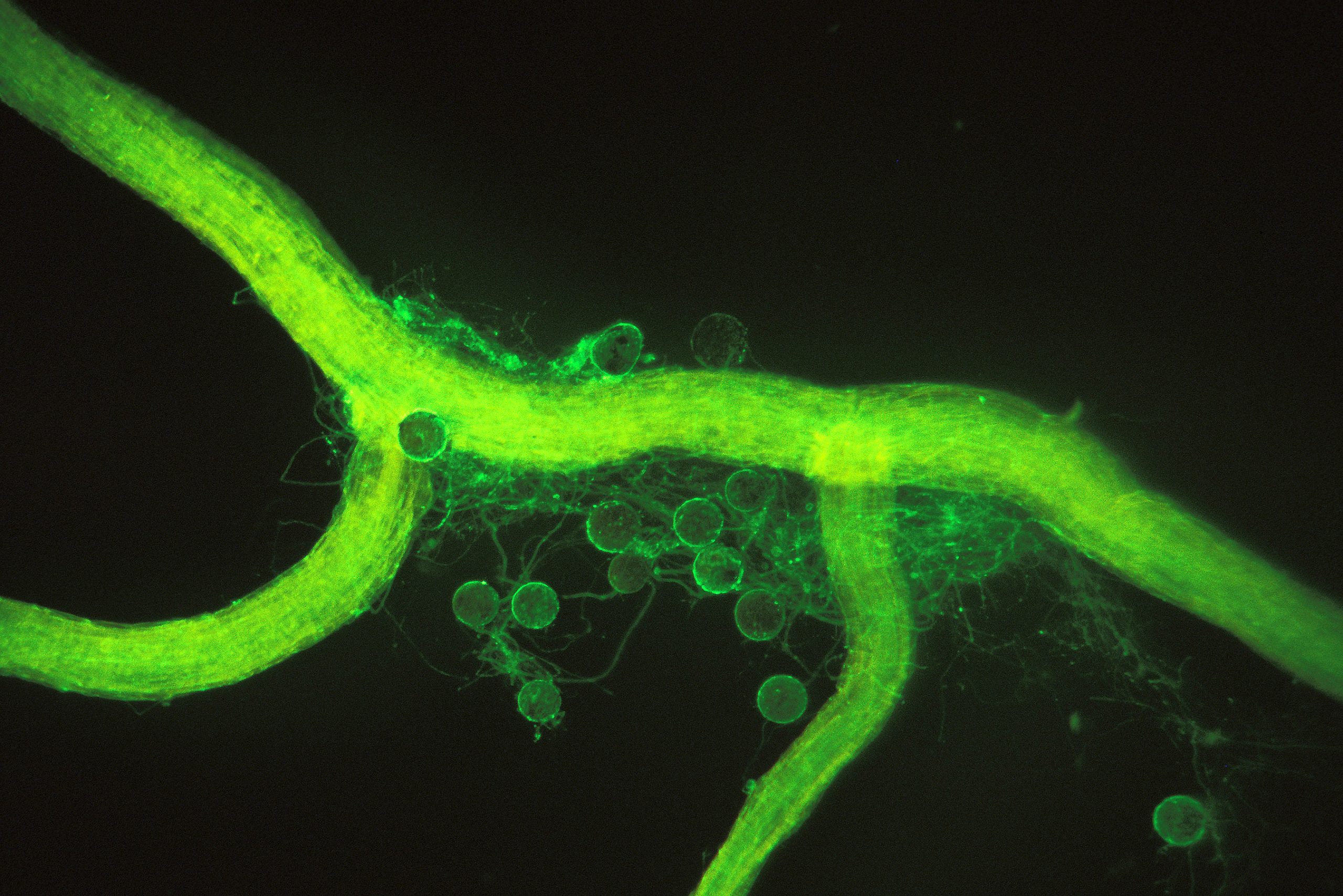
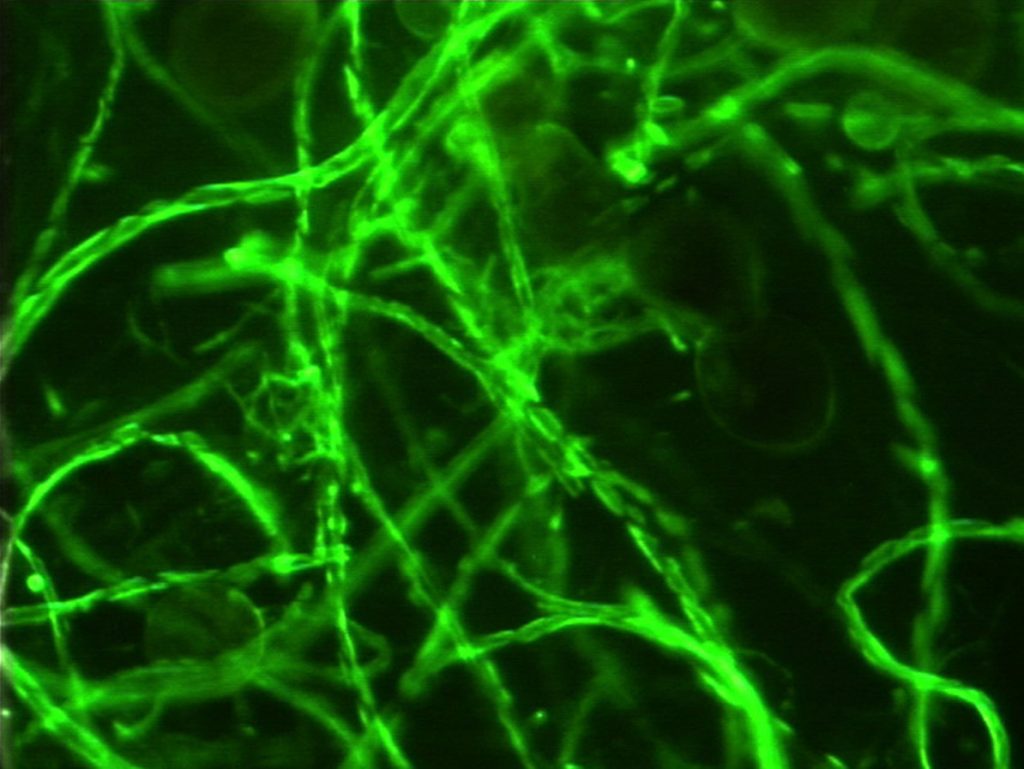
A mycorrhiza (plural mycorrhizas or mycorrhizae) is a partnership between a fungus and a plant root. The word comes from the Greek for “fungus” and “root”. The fungus grows a mesh of microscopic threads called hyphae through the soil. Because these threads are far thinner than roots and can reach into tiny pores, they are very good at gathering water and nutrients such as phosphorus and nitrogen. The plant, in turn, supplies the fungus with sugars and fats made by photosynthesis.
This is not a niche arrangement. In a major 2009 review in Plant and Soil, mycorrhizal researcher Mark Brundrett estimated that about 74% of flowering plant species form arbuscular mycorrhizas, 9% form orchid mycorrhizas, 2% form ectomycorrhizas, and 1% form ericoid mycorrhizas, while only around 6% are non-mycorrhizal.
| Type | How the fungus meets the root | Typical partners | Does it make mushrooms? |
|---|---|---|---|
| Arbuscular mycorrhizas | Hyphae enter root cells and form tiny branched structures called arbuscules, where nutrients are exchanged | Most crops, grasses, and many trees | No. These fungi form spores in soil and roots, not mushrooms |
| Ectomycorrhizas | Hyphae wrap the root tip in a sheath and grow between, not into, the outer root cells | Many temperate and boreal trees, including pines, oaks, birches, and beeches | Yes. Many familiar forest mushrooms are the fruiting bodies of ectomycorrhizal fungi |
That second row is why this topic belongs on a mushroom site. Many celebrated wild mushrooms, including chanterelles and truffles, live in partnership with living trees. So does the deadly death cap, which is why it turns up under oaks rather than on dead logs. Their dependence on a living host is also a large part of why such species are far harder to farm than oysters or shiitake, which feed on dead wood and other plant material, as explained in our guide to mushroom substrates.
The modern story starts with a field experiment published in Nature in 1997. Suzanne Simard and colleagues labelled paper birch and Douglas-fir seedlings growing together in a British Columbia forest with two different forms of carbon, so they could trace where each tree’s carbon went. They found carbon moving in both directions between the two species. Over the experiment, the Douglas-firs came out ahead, with a net gain averaging about 6% of the labelled carbon they had taken up through photosynthesis. Western redcedar seedlings, which did not form ectomycorrhizas, picked up very little label. Shading the Douglas-firs changed the amount of net transfer, which the authors interpreted as carbon flowing from source to sink.
The journal’s cover called it the “wood-wide web”, and the phrase stuck. Over the next two decades it was expanded in popular books, talks, and films into a vivid picture of forests as cooperative communities wired together by fungi.
A second widely cited study came in 2016. Tamir Klein, Rolf Siegwolf, and Christian Körner used a construction crane in a Swiss forest near Basel to flood the crowns of 40-metre Norway spruce trees with carbon dioxide carrying a distinctive isotope signature. They later found that label in the fine roots of neighbouring trees, including beech, pine, and larch. The University of Basel’s summary of the Science paper explains that the team attributed the transfer to shared ectomycorrhizal fungi, partly because understory plants that host other fungal types stayed unlabelled.
In 2023, three mycorrhizal ecologists, Justine Karst, Melanie Jones, and Jason Hoeksema, published a review in Nature Ecology & Evolution that tested the three most repeated claims against the field evidence. Melanie Jones was a co-author on Simard’s 1997 paper, which made the review hard to dismiss as an outsider’s attack. Here is how each claim fares.
Verdict: possible, but far less established than often stated.
Showing that two trees share the same individual fungus is technically difficult. It requires genetically mapping both the trees and the fungal individuals in the soil. The 2023 review found that only five such mapping studies had been done, in two forest types, covering only two tree species of an estimated 73,300 worldwide. Only two studies demonstrated physical continuity of the fungal links between trees, and nobody yet knows how long such connections typically last.
Verdict: mixed. Transfer can happen, but benefits to seedlings are inconsistent.
The isotope studies are real results: carbon and other substances do move between plants below ground. The harder question is the route and the effect. Carbon can also move through root grafts, leakage from roots into soil, and other soil pathways. Karst and colleagues examined 26 field studies and concluded that their results could be explained without invoking fungal networks. Only five experiments (18%) showed clear positive network effects on seedlings that were not offset by root effects. Overall, they found roughly equal evidence that connecting to a network helps or hinders seedlings, with neutral effects being most common.
Verdict: not supported by published field evidence.
This is the most famous part of the story and the weakest. The 2023 review stated that it found no evidence from peer-reviewed, published studies in forests to support the claim that mature trees preferentially send resources or defence signals to their offspring through fungal networks. The main greenhouse study on stress signalling lost its effect when roots were allowed to grow together, and the kin-recognition work cited for the idea came from theses that either did not test the claim or contradicted it.
The 2023 review did more than reassess experiments. It also tracked how scientific papers cited the influential studies. The authors reviewed 593 papers citing key studies on network structure and 1,083 papers citing key studies on network function. They report that unsupported statements, where a paper claimed more than the cited study showed, had roughly doubled over 25 years, reaching about a quarter of citations about structure and almost half of citations about function. They describe this as positive citation bias: each retelling rounds a cautious finding up into a confident one.
Language played a part too. Words such as “communicate”, “nurture”, “share”, and “mother” make complex ecology memorable, but they can also smuggle in intentions and kinship that the data never tested. The reviewers specifically urged scientists to reconsider anthropomorphic language and to gather more evidence before forest management decisions are made on the basis of protecting networks.
The original researchers have pushed back. In January 2025, Suzanne Simard, Teresa (Sm’hayetsk) Ryan, and David Perry published an opinion article in Frontiers in Forests and Global Change responding to Karst and colleagues and to two other critical papers from 2023. Their main arguments include:
The response also questions how the review selected influential studies and notes that Karst and colleagues co-authored a share of the papers they flagged for citation bias.
Read side by side, the two camps agree on more than headlines suggest. Neither disputes that mycorrhizal fungi are vital, that fungal threads can link more than one plant, or that substances can move between plants below ground. The disagreement is about how common lasting networks are in real forests, how much they actually change seedling survival compared with other factors such as light and root competition, and whether anything resembling kin-directed care exists. Those are open scientific questions, and the honest answer for now is “it depends, and we need more field data.”
| Popular statement | What the evidence supports |
|---|---|
| “Trees talk to each other through fungi.” | Some studies report resources and chemical signals moving below ground, but that is not communication in any human sense, and the route is often unclear |
| “Every tree in a forest is connected.” | Network connections have been mapped in only a handful of sites and tree species |
| “Mother trees feed their own seedlings.” | No peer-reviewed field evidence currently shows preferential transfer to offspring |
| “Fungal networks help seedlings survive.” | Sometimes. Field results include positive, negative, and neutral effects |
| “Mycorrhizal fungi are essential to most plants.” | Yes. Most plant species form mycorrhizas, and the partnership supplies water and nutrients |
| “Underground fungi matter for the climate.” | Researchers estimate they draw large amounts of carbon into soils each year, but the figures are model-based estimates |
Stripping away the exaggeration does not make mycorrhizal fungi less important. In July 2025, the Society for the Protection of Underground Networks (SPUN) and partners published global maps in Nature based on about 25,000 soil samples from 130 countries and more than 2.8 billion fungal DNA sequences. According to the University of Tartu’s summary of the study, only 9.5% of the richest hotspots of mycorrhizal fungal diversity fall within existing protected areas. The same summary cites an estimate that mycorrhizal fungi draw about 13 billion tonnes of carbon dioxide per year into soils; that figure is an estimate from earlier modelling work, not a direct measurement.
These are the reasons to care about soil fungi: they feed plants, shape which trees and mushrooms grow where, store carbon, and are poorly protected. None of that depends on trees having feelings.
The “wood wide web” began as a genuine discovery: fungi link plant roots, and carbon can move between trees. It grew into a cultural metaphor that outran the evidence. The most defensible position today is that mycorrhizal partnerships are fundamental, that shared networks exist in at least some forests, that their effects on seedlings vary from helpful to harmful, and that claims about mother trees and deliberate communication remain unproven. The fungi underfoot are remarkable enough without the embellishment, and the next generation of field studies should tell us how much of the network story will survive.
Featured image: arbuscular mycorrhizal fungus on a corn root. Photo by Sara Wright, USDA Agricultural Research Service (public domain).



[…] The summary describes these as “among very few field tests of mycoremediation in the United States”. They’re encouraging, but they’re one programme, and the authors call for more field studies and larger pilots. Mycorrhizal fungi, which partner with plant roots, are explained in our article on the “wood wide web”. […]
[…] are harmless or helpful. They recycle nutrients, partner with plant roots, as our article on the “wood wide web” explains, and give us foods and […]