Physical Address
304 North Cardinal St.
Dorchester Center, MA 02124
Physical Address
304 North Cardinal St.
Dorchester Center, MA 02124

Only a small number of fungi can make their own light. Here's how bioluminescent mushrooms glow, what research says about why, and why the glowing jack-o'-lantern mushroom is poisonous.
Walk through certain forests on a dark, damp night and you might see something strange: a soft green light coming from a log or a cluster of mushrooms. Glowing fungi have long fascinated people, and they’ve also become a serious research topic, with scientists working out exactly how the light is made, why fungi bother making it, and whether the trick can be borrowed for other living things.
This guide explains what we know about bioluminescent mushrooms, what the research shows, and why the most famous glowing mushroom in North America belongs on your “do not eat” list.
Bioluminescence, light made by a living organism, is rare in fungi. Estimates vary slightly between sources:
| Source | Estimate |
|---|---|
| Mongabay (2013) | Bioluminescence verified in “only 71 of the roughly 100,000 described species” of fungi |
| Dartmouth (2015) | Only 71 of more than 100,000 known fungal species produce light |
| Discover (2017) | “Roughly 80 species of bioluminescent fungi scattered throughout the world” |
| ScienceDaily (2018), reporting a PNAS study | “There are over 100 species of mushrooms that emit light” |
Whichever figure you use, glowing fungi make up a tiny fraction of fungal species. They’re found in many parts of the world, and according to Discover they typically appear as small, glowing green mushrooms near the bases of trees and in the underbrush.
Discover notes that glowing mushrooms use the same basic trick as fireflies. It explains that the light comes from an interaction between a compound called luciferin and an enzyme called luciferase, in the presence of oxygen. The reaction produces a molecule called oxyluciferin, and light is released as it returns to a lower energy state.
A 2012 study by Oliveira and colleagues, reported by Mongabay, found evidence of “a single luminescent pathway” shared by glowing fungi. In other words, the many species that glow seem to use the same basic chemical system, rather than having invented it separately many times.
A key discovery came in 2018. ScienceDaily reported on a study in PNAS led by Ilia Yampolsky, with Fyodor Kondrashov of the Institute of Science and Technology Austria as a co-author. The team worked out the full set of genes that the fungus Neonothopanus nambi uses to make its light.
The surprising part was where fungal luciferin comes from. According to the report, it is “only two enzymatic steps away from” caffeic acid, a compound that plants commonly make. That closeness is what makes the next part of the story possible.
Glowing fungi normally give off green light. Discover reports that researchers were able to produce other colours in the lab by reacting different compounds with luciferase, but in nature, the glow you see is green.
| Step | What happens |
|---|---|
| 1 | The fungus makes luciferin, which is chemically close to caffeic acid |
| 2 | The luciferase enzyme acts on luciferin in the presence of oxygen |
| 3 | The reaction produces oxyluciferin in an excited state |
| 4 | Oxyluciferin releases energy as green light |
For a long time, nobody knew whether the glow had a purpose or was just a by-product of the fungus’s chemistry. Two ideas have received the most attention.
The best evidence comes from a 2015 study in Current Biology by Oliveira and colleagues, led by Jay Dunlap at Dartmouth and Cassius Stevani of the University of São Paulo in Brazil. They studied Neonothopanus gardneri, a glowing mushroom known locally as “flor de coco”, which grows at the base of young palm trees in Brazil.
The team made two important findings:
Stevani summed it up: “It appears that fungi make light so they are noticed by insects who can help the fungus colonize new habitats.” The idea is that insects visiting a mushroom pick up spores and carry them elsewhere.
Another idea is that the light-producing reaction does something useful for the fungus regardless of the glow. Mongabay’s report notes that the reaction “provides some antioxidant protection”. This doesn’t rule out the insect theory. The two explanations may both play a part.
Not every expert treats the insect theory as settled. In Mongabay’s 2013 report, San Francisco State University mycologist Dennis Desjardin said insects are attracted to glowing mushrooms, but whether this helps spread spores “is unknown”. The 2015 decoy experiment showed that insects come to the light. It didn’t directly measure how much that helps the fungus spread.
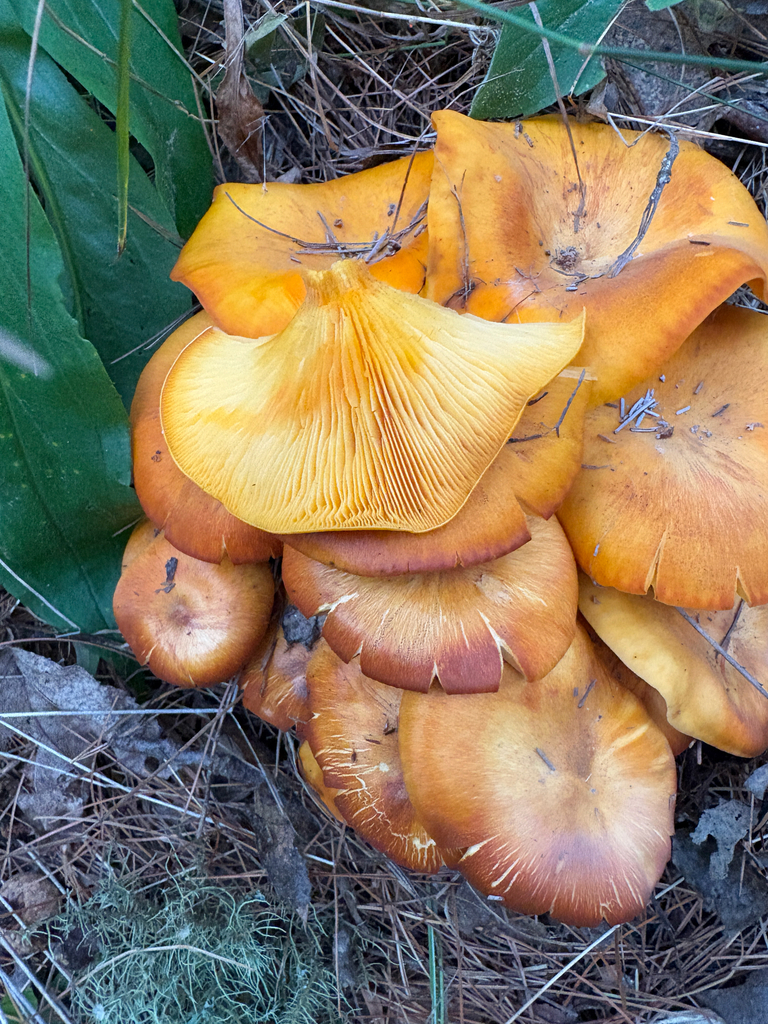
One of the best-known glowing mushrooms in North America is the jack-o’-lantern, Omphalotus illudens. It is also one of the most important mushrooms for foragers to recognise, because it is poisonous and is often mistaken for an edible favourite.
The Missouri Department of Conservation describes the jack-o’-lantern as bright orange and notes that it appears in the fall. Key features from the Missouri Department of Conservation and NC State Extension:
Yes, but don’t expect a bright lamp. The Missouri Department of Conservation says that “the gills of fresh specimens may sometimes give off a faint greenish glow at night or in a darkened room.” NC State Extension also lists the gills as bioluminescent. Older field guides sometimes used the name Omphalotus olearius for the North American species, but NC State Extension notes that this name was applied to it in error.
The Missouri Department of Conservation is direct: “Eating Jack-o’-lantern mushrooms will make you very sick for a few days.” NC State Extension rates the poison severity as medium and describes symptoms including severe stomach ache, nausea and vomiting. According to NC State Extension, symptoms start 1 to 3 hours after eating, and recovery takes several days.
If you think someone has eaten a jack-o’-lantern or any unidentified wild mushroom, contact a poison control centre or seek medical help straight away. Our guide to mushroom poisoning symptoms and what to do explains the steps in more detail.
The Missouri Department of Conservation warns that people often mistake jack-o’-lanterns for edible chanterelles. The single most useful check, according to the department, is to look underneath.
| Feature | Jack-o’-lantern (Omphalotus illudens) | Chanterelle |
|---|---|---|
| Underside | True gills | Smooth underneath, according to the Missouri Department of Conservation |
| Growth | Large clusters, at the base of trees, on stumps or on buried wood | Not covered in the sources used for this article |
| Glow | Fresh gills may glow faintly green | Not described as glowing in these sources |
| Edibility | Poisonous | Edible |
This comparison is a starting point, not a complete identification guide. Different experts use several features together, and a single check can mislead a beginner. If you’re curious about chanterelles, our article on chanterelles covers them in more depth. Never eat a wild mushroom unless an experienced local expert has confirmed its identity. Photo apps can help you learn, but our look at mushroom identification apps explains why they shouldn’t be trusted to decide what’s safe to eat.
Scientists are already using fungal light outside the forest.
In the 2018 PNAS study, the team inserted the fungal light genes into a yeast called Pichia pastoris. The yeast then glowed on its own. Kondrashov explained what made this different from earlier glowing organisms: “We don’t supply a chemical that makes the yeast glow”. The yeast made its own luciferin from its own resources.
Because fungal luciferin is so close to caffeic acid, which plants already make, the researchers saw potential for glowing plants. But Kondrashov was cautious about timelines. A glowing plant bright enough to work as a street light, he said, “may take several years”.
Fungi have also been tested as a light source in their own right. The Technical University of Dresden ran a project called “Foxfire” between 2020 and 2022, funded by the German Federal Ministry of Education and Research. It focused mainly on the glowing fungus Panellus stipticus and aimed to create a biological alternative to disposable chemical glow sticks.
According to the project page, the team developed a light source based on compostable materials. But the light was limited in brightness, so its uses are restricted to marker lighting rather than lighting a room.
| Project | Organism | Result | Limitation |
|---|---|---|---|
| PNAS study (2018) | Yeast carrying fungal genes | The yeast glowed without added chemicals | Glowing plants for street lighting “may take several years” |
| TU Dresden “Foxfire” (2020 to 2022) | Panellus stipticus | Compostable light source | Light output limited, suited to marker lighting |
If you’d like to see fungal light for yourself, a few sensible points:
Glowing mushrooms are a reminder that fungi do far more than most people realise. If you enjoyed this article, our piece on the real fungus behind The Last of Us looks at another fungus with a remarkable trick.
Only a small number of fungi, somewhere between about 70 and just over 100 species depending on the source, can make their own light. They share one chemical pathway, in which luciferin reacts with luciferase and oxygen to produce a green glow. Research in Brazil suggests some mushrooms glow to attract insects that may help spread their spores, though experts still debate how much that matters. Scientists have already moved the fungal light genes into yeast, and glowing plants may follow. Meanwhile, North America’s best-known glowing mushroom, the jack-o’-lantern, is poisonous. Enjoy its glow, but leave it off your plate.
Featured image: jack-o’-lantern mushrooms by jeffcherry via iNaturalist (CC0 1.0).