Physical Address
304 North Cardinal St.
Dorchester Center, MA 02124
Physical Address
304 North Cardinal St.
Dorchester Center, MA 02124

A practical checklist of mushroom foraging kit, from baskets and wax paper to knives, hand lenses and tick protection, with responsible picking rules from mushroom clubs and foraging codes.
A good foraging trip starts before you leave the house. The right kit keeps your mushrooms in good condition, helps you identify them properly, and gets you home safely. The wrong kit, such as a plastic carrier bag, can turn a basket of finds into a soggy mess and make identification harder.
This checklist draws on equipment advice from two long-running mushroom clubs, the Mycological Society of San Francisco (MSSF) and the Wisconsin Mycological Society, plus foraging codes from the UK and Scotland, the North American Mycological Association (NAMA), and the US Centers for Disease Control and Prevention (CDC).
One rule sits above all the kit: never eat a wild mushroom unless its identity and edibility have been reliably confirmed. NAMA puts it plainly, and so do we. No piece of equipment makes a mushroom safe.
Not all land is open to foraging, and the rules vary by country and site.
| Item | Why you need it | Source |
|---|---|---|
| A rigid basket or box | Gets mushrooms home in good condition. A shallow basket is best | Wisconsin Mycological Society |
| Wax paper, wax paper bags or small paper bags | Keeps each type of mushroom separate and protects it from crushing | Wisconsin Mycological Society |
| Small containers | For small or delicate mushrooms. Small jars or berry baskets work | Wisconsin Mycological Society; MSSF suggests a compartmented fishing box |
| A knife | To dig up the whole mushroom for identification, and to trim mushrooms you plan to eat | Wisconsin Mycological Society |
| A brush | To clean off dirt as you collect | MSSF |
| A 10x hand lens | To examine small features in the field | MSSF |
| A field guide | To identify mushrooms where you find them | Scottish Wild Mushroom Code; BMS code |
| Notebook and pencil | To record where and how each mushroom was growing | Wisconsin Mycological Society; NAMA |
| Camera or phone | To photograph mushrooms in their habitat | MSSF; NAMA |
Both clubs are firm on this. MSSF’s list simply says “Not plastic bags!” The Wisconsin Mycological Society says plastic bags shouldn’t be used to hold specimens except for short periods, because they don’t give fungi enough ventilation. MSSF explains that porous containers, such as paper, grocery or cloth bags, keep condensation from building up and rotting your collections.
Wrapping each kind of mushroom separately isn’t just about keeping them tidy. If you’re unsure of one find, keeping it apart from the others stops pieces of an unknown or poisonous mushroom getting mixed in with the ones you plan to eat. Never put a mushroom you can’t identify in the same bag as your edibles. A quick pencil note on each bag, saying where and on what it was growing, links every find to your field notes.
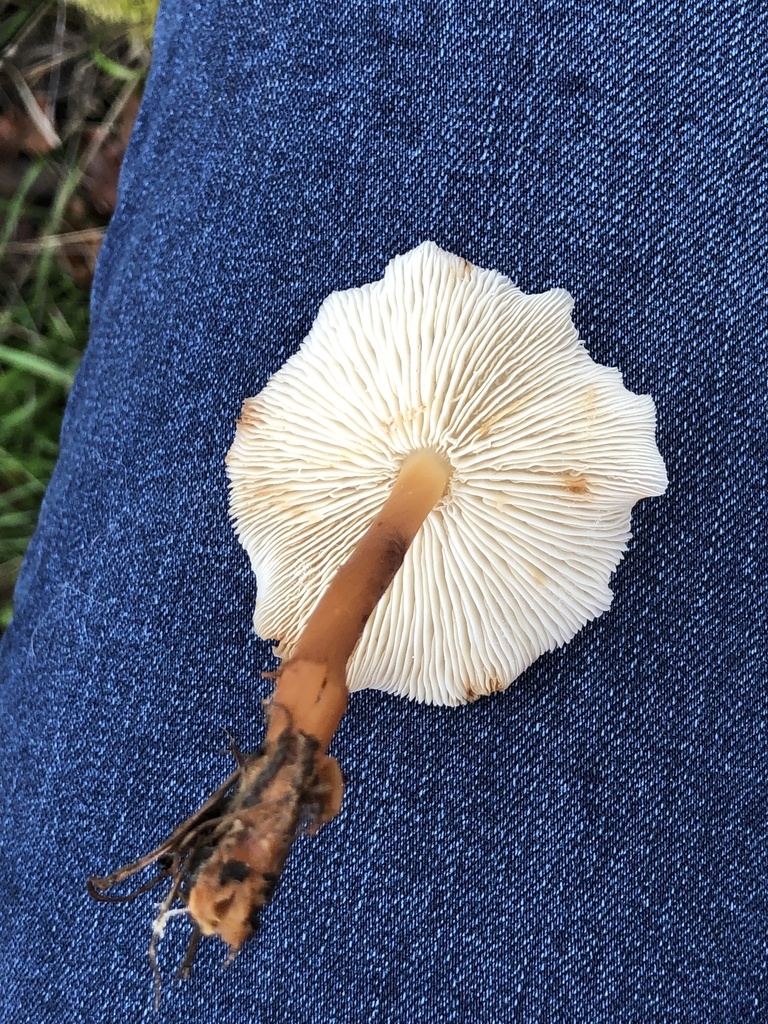
The base of a mushroom often holds important identification features. NAMA advises removing the entire mushroom carefully, rather than breaking off only the cap. This matters most with dangerous groups, such as the death cap and its relatives, where features at the very base of the stem are important clues.
MSSF suggests carrying two knives: a sharp paring knife for cleaning and trimming, and a slightly larger one for digging out bases, which will dull quickly. Small scissors are handy for trimming dirty bases on small mushrooms.
A 10x hand lens is the standard field magnifier, according to MSSF. It shows small features like hairs, gill edges and textures that are easy to miss. If you get hooked on identification, our guide to mushroom microscopy for beginners is the next step. For many species, a spore print made at home is also an essential clue.
Notes and photos make identification far easier back at home. NAMA recommends recording:
NAMA adds that photos of a mushroom in its natural habitat can often teach you more than a basket of unidentified specimens. Photograph the top, the underside and the base before you pick, and include something for scale.
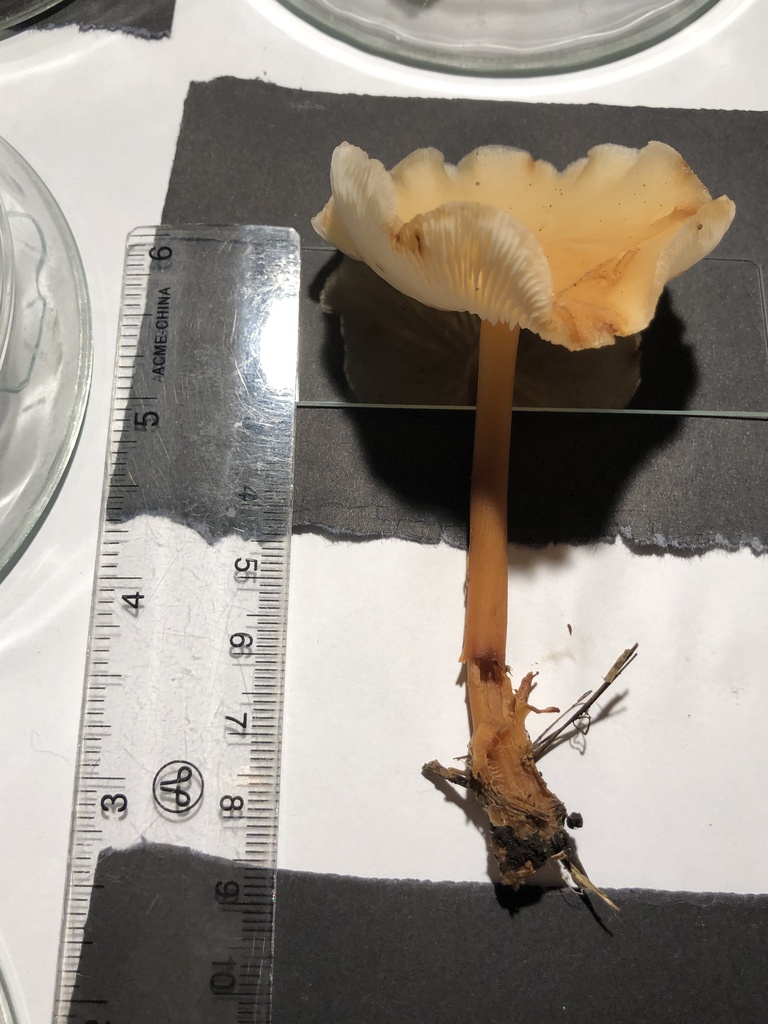
MSSF’s equipment list puts a lot of weight on personal safety, and much of it depends on where you’re going.
| Item | Why | Source |
|---|---|---|
| Map, compass and GPS | A compass needs no batteries and works in wet forest. GPS maps build confidence in unfamiliar woods | MSSF; Wisconsin Mycological Society |
| Whistle | Carries further than shouting if you’re lost | Wisconsin Mycological Society |
| Suitable footwear | Woods can be wet, muddy, slippery or snowy | MSSF |
| Weather-appropriate clothing | Rain gear and spare dry clothes, or warm layers in cold weather. MSSF warns that not having warm clothes “can be fatal” | MSSF |
| Water, food and any medication | Keeps you going on a long walk | MSSF |
| Insect repellent | For biting insects and ticks | Wisconsin Mycological Society; MSSF |
It also helps to tell someone where you’re going and when you expect to be back, especially if you forage alone.
Leaf litter is exactly where many mushrooms grow, and it’s also tick habitat. The CDC lists wooded and brushy areas with high grass and leaf litter as places to take care. Its advice includes:
Advice on repellents and products varies between countries, so check what’s recommended and approved where you live.
Good kit goes with good habits. Foraging codes from the UK and Scotland agree on the basics:
How you carry mushrooms matters as much as how you pick them. MSSF suggests a basket that holds at least a couple of gallons, with a cover to keep out leaves and debris. It also calls it “imperative” to brush all the dirt off each mushroom as it goes into the basket. Wax paper or foil wrapping, MSSF adds, protects finds from dirt, crushing and drying out.
On a warm day or a long drive, MSSF recommends an ice chest. It notes that mushrooms keep best at around 34°F (about 1°C), the temperature commercial growers recommend. Keep the porous bags inside the cool box, rather than sealing mushrooms in plastic.
Before you set off, run through this list:
Back home, sort your finds straight away. Set aside anything you can’t identify with certainty. Clean and refrigerate the mushrooms you’re keeping, or preserve them. Our guide to drying mushrooms at home covers one easy way to store a good haul.
If you’re new to foraging, the best piece of kit is an experienced guide. Both NAMA and the BMS code recommend learning on organised forays or field courses led by experts. Local mushroom groups run walks, especially in autumn, which is peak mushroom season in many places.
Featured image: a mushroom collected whole by Angelique via iNaturalist (CC0 1.0). Inline photo by Angelique via iNaturalist (CC0 1.0).