Physical Address
304 North Cardinal St.
Dorchester Center, MA 02124
Physical Address
304 North Cardinal St.
Dorchester Center, MA 02124

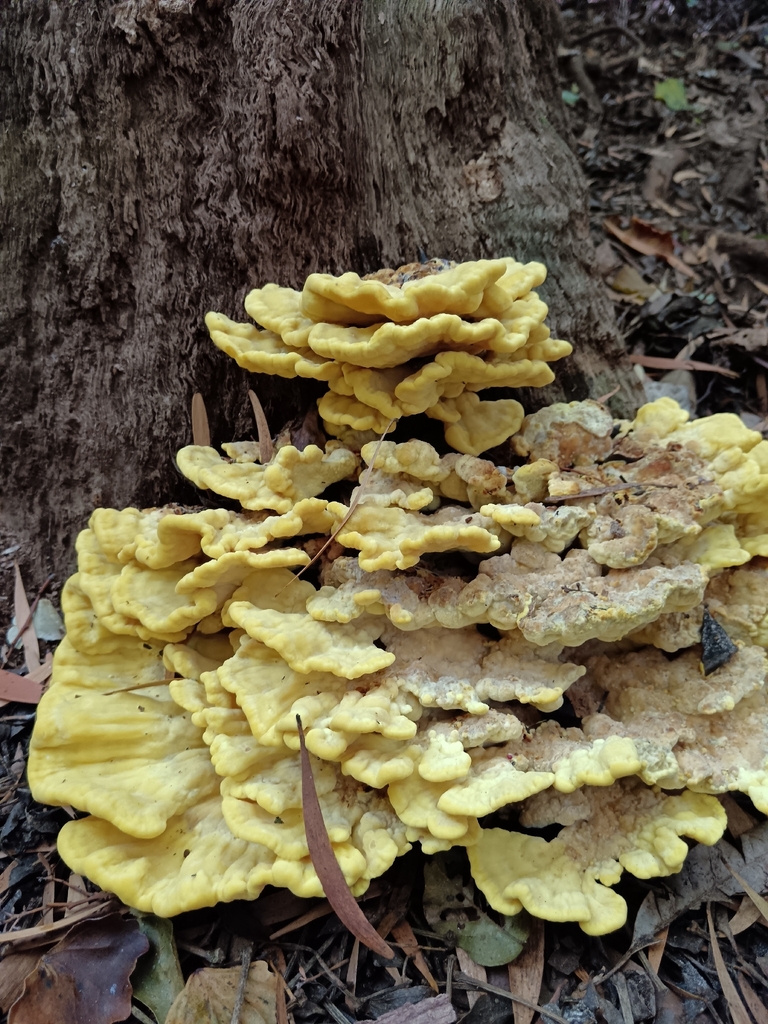
Chicken of the woods and hen of the woods are different fungi. Compare their colour, shape, pores and host trees, learn the lookalikes, and see why experts urge caution even with these popular edibles.
Chicken of the woods and hen of the woods sound like they should be close relatives. Both are large, edible polypores that grow on or near hardwood trees, and both are favourites with foragers. But they are different fungi that look quite different once you know what to check.
This guide compares the two side by side, covers the lookalikes for each, and explains the safety points that experts stress for both, including why “edible” doesn’t mean everyone can eat them without a problem.
Chicken of the woods is a group of bright orange and yellow shelf fungi in the genus Laetiporus. Hen of the woods, also called maitake, is Grifola frondosa, a grey-brown rosette of many small caps that grows at the base of trees. The colour alone usually tells them apart, but colour fades with age, so it’s worth learning the other differences too.
| Feature | Chicken of the woods (Laetiporus sulphureus) | Hen of the woods (Grifola frondosa) |
|---|---|---|
| Colour | Orange-red to orange-yellow caps, lighter with age (Missouri Department of Conservation) | Grey to grey-brown caps (Missouri Department of Conservation) |
| Shape | Overlapping fan-shaped shelves, with no stalk | A rosette of many spoon- or fan-shaped caps on a shared, branched base |
| Underside | Bright sulphur-yellow pores | White to yellowish pores |
| Where it grows | On dead or dying deciduous trees, stumps, buried roots and living trees | On the ground at the base of oak trees or stumps |
| Season in Missouri | May to November | September to November |
| Spore print | White | White |
| Type of rot | Brown rot (Kew) | White butt rot (Kuo) |
The name “chicken of the woods” covers several closely related species. Mycologist Michael Kuo’s key on MushroomExpert.com lists seven Laetiporus species and varieties in North America. In the UK, according to Kew’s Grow Wild project, Laetiporus sulphureus is the only species.
The Missouri Department of Conservation describes Laetiporus sulphureus this way:
Kew adds that the brackets are “velvety when young” and that fresh flesh is soft, moist and faintly lemony. The underside has “tiny round pores at 2–4 per mm rather than gills.”
Chicken of the woods grows on wood. In Missouri it appears on dead or dying deciduous trees, stumps, buried roots and living trees. In the UK, Kew lists oak, sweet chestnut, beech and yew as its main hosts, along with cherry and willow.
It is a brown rot fungus. Kew explains that its mycelium “tunnels into the heartwood of oaks and sweet chestnuts”, slowly hollowing the wood over decades. That’s bad news for timber, but the resulting cavities provide homes for bats, owls and many invertebrates.
Kuo’s key separates North American species mainly by pore colour, host tree and region:
| Species | Pore colour | Host and region (Kuo) |
|---|---|---|
| L. sulphureus | Yellow | Oaks, Great Plains eastward |
| L. cincinnatus | White to cream | Rosettes at the bases of oaks, Great Plains eastward |
| L. gilbertsonii | Yellow | Eucalyptus or oaks on the West Coast and in Mexico |
| L. conifericola | Not used to separate it in the key | Conifers, Rocky Mountains westward |
| L. huroniensis | Not used to separate it in the key | Conifers, northern Midwest and Northeast |
Laetiporus cincinnatus is worth singling out. The Missouri Department of Conservation calls it the pale chicken of the woods and notes its white underside. Because it grows in rosettes at the base of oaks, it can be found in the same kind of spot as hen of the woods, which is one reason it pays to check the colour of the cap and pores.
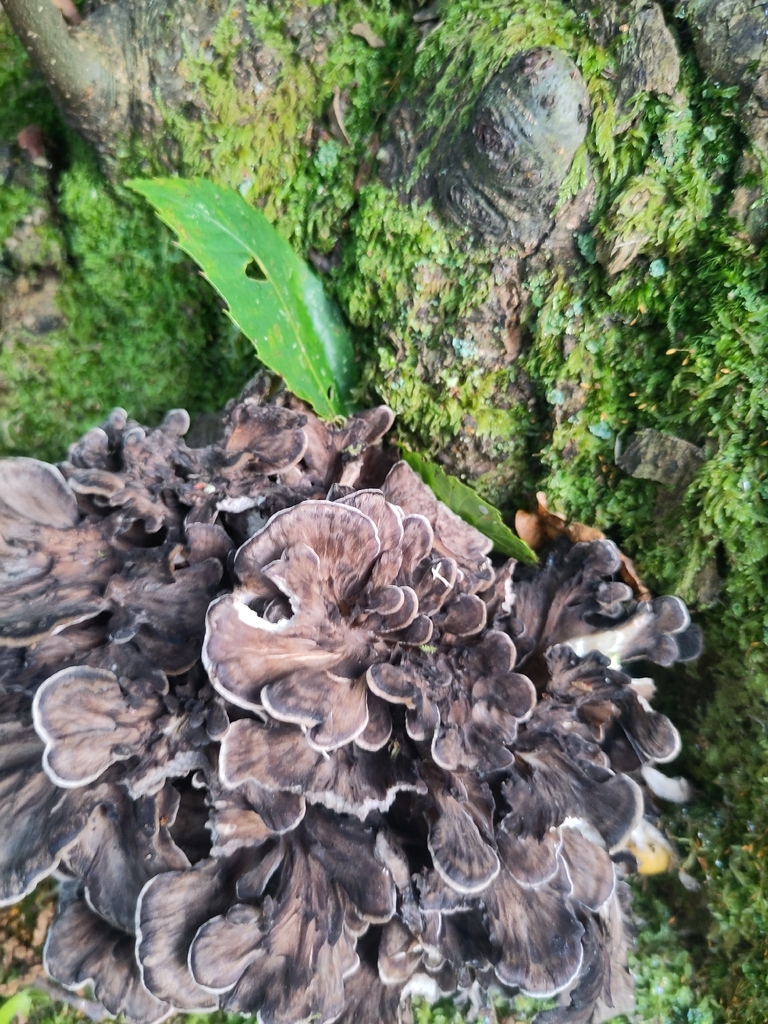
Hen of the woods is the same mushroom sold as maitake. We cover cooking and buying it in our maitake guide. Here we focus on identification.
The Missouri Department of Conservation describes a “large circular cluster of spoon-shaped caps” growing from a single, branching, whitish base. Key details:
Kuo adds that the pores run down the stem, are lavender-grey when young and become white to yellowish with age, and don’t bruise. The flesh is firm and white.
Hen of the woods grows on the ground at the base of oak trees or stumps, according to the Missouri Department of Conservation, often in moist hardwood forests and river bottoms with mature trees. Kuo says it is found near the bases of oaks and other hardwoods, where it causes a white butt rot. He describes it as weakly parasitic on living trees and able to live on decaying wood.
Both sources note that it tends to come back. The Missouri Department of Conservation says, “It is often found on the same tree year after year, so check your spot every autumn.” Kuo reports it is widely distributed east of the Rocky Mountains and rare in the West.
Both mushrooms have lookalikes worth knowing before you pick anything.
The Missouri Department of Conservation says, “No other Missouri mushrooms have the color, shape, and growing habit of the two ‘chicks'”, meaning the yellow-pored and white-pored species. That’s reassuring, but it applies to Missouri. Other regions have different fungi, and the host tree can also matter for safety, as covered below.
| Lookalike | How it differs, according to our sources |
|---|---|
| Black-staining polypore (Meripilus sumstinei) | Blackens when bruised or handled (Missouri). Kuo adds that it has larger caps and smaller pores. |
| Berkeley’s polypore (Bondarzewia berkeleyi) | Thick-fleshed and cream-coloured (Missouri) |
| Eastern cauliflower mushroom (Sparassis spatulata) | Has ribbon-like folds (Missouri) |
| Polyporus umbellatus | Has more clearly defined individual caps and stems (Kuo) |
| Pale chicken of the woods (Laetiporus cincinnatus) | Orange caps and white to cream pores, also at the base of oaks (Kuo) |
Both mushrooms are popular edibles, but experts give the same cautions for each.
The Missouri Department of Conservation says some people get stomach upset or swollen lips after eating chicken of the woods. For both species, it advises being absolutely sure of the identification and eating only a small amount the first time. Kew warns that some people react badly even to properly cooked chicken of the woods.
Reports collected by the North American Mycological Association (NAMA) show this in practice. Its 2017 summary of voluntary reports lists cases under “normally edible species”, including:
| Species | Cooked? | Symptoms reported |
|---|---|---|
| Laetiporus cincinnatus | Yes | Nausea, vomiting |
| Laetiporus sulphureus | Yes | Intestinal cramps, vomiting, nausea, constipation. Onset 10 hours |
| Grifola frondosa | Yes | Intestinal cramps, nausea, pain. Onset 0.5 hours |
The report is clear about its limits. Its author, Michael Beug, writes that NAMA learns about “less than 1% of all cases” and that “no conclusions can be drawn” from the voluntary, fragmentary data. These are individual reports, not evidence about how common reactions are.
Kew says the young, soft margin of chicken of the woods must be cooked thoroughly and should never be eaten raw. The Missouri Department of Conservation also says to cook it well. For hen of the woods, it suggests simmering fresh, tender portions “slowly in salted water until tender.” Our article on eating mushrooms raw explains why cooking is the safer habit for many mushrooms.
Kew warns: “Never eat specimens growing on yew”, because they may absorb toxic compounds from the tree. Kuo’s key shows that some Laetiporus species grow on conifers and eucalyptus. Ask an experienced local expert about the host trees and species in your area before eating any find.
The Missouri Department of Conservation says older chicken of the woods becomes tough. It suggests cutting off the tender outer edges and leaving the rest on the tree. For hen of the woods, it recommends using only fresh, tender portions.
Kew’s position is that “we do not recommend picking or eating wild mushrooms.” If you do forage, follow local rules and harvest lightly. The Missouri Department of Conservation advises hen of the woods foragers to “harvest what you need and leave the rest to continue growing.” Our foraging kit checklist covers what to bring.
If you’d rather not forage at all, hen of the woods is widely sold as maitake, and you can try growing it yourself with our guide to growing maitake.
Chicken of the woods is bright orange and yellow, grows as shelves on wood and has yellow pores (or white pores in the pale species). Hen of the woods is grey-brown, grows as a rosette of small caps at the base of oaks and has white pores. Both are popular edibles, but some people react to them even when they’re cooked, and chicken of the woods from yew should never be eaten. Be certain of the identification, cook thoroughly, and start with a small amount.
Featured image: chicken of the woods by AdventureLisa via iNaturalist (CC0 1.0).