Physical Address
304 North Cardinal St.
Dorchester Center, MA 02124
Physical Address
304 North Cardinal St.
Dorchester Center, MA 02124

Some fungi can break down polyurethane, polypropylene and polyethylene, but mostly in the lab, slowly and after pretreatment. Here are the key discoveries and why fungi won't fix plastic pollution on their own.
Every few months a headline announces a “plastic-eating fungus”. The idea is irresistible: a living organism that could quietly digest the plastic piling up in landfills and oceans. Some of these discoveries are real, and a few are genuinely impressive. But between a petri dish and a polluted beach there’s a long way to go.
This article looks at the best-known plastic-degrading fungi, what the studies actually measured, and why scientists say fungi won’t solve the plastic problem on their own.
Fungi are expert decomposers. Wood-rotting species break down lignin and cellulose, some of the toughest materials in wood, using enzymes they release into their surroundings. Our article on mycoremediation explains how those same enzymes are being tested against oil, pesticides and other pollutants. Plastic is the next obvious target.
The scale of the problem explains the interest. A 2018 UN News report on Kew’s first State of the World’s Fungi report noted that at least eight million tonnes of plastic enter the sea each year. The Royal Netherlands Institute for Sea Research (NIOZ) says humans now produce over 400 billion kg of plastic a year, an amount expected to at least triple by 2060.
More than you might think. A 2022 review in the Journal of Fungi by Ekanayaka and colleagues counted “more than 200 records of fungi capable of degrading different plastic types”. It found these fungi spread across 11 classes in three major fungal groups, with Aspergillus and Penicillium moulds among the most commonly reported.
The review covered conventional plastics such as PET, polyethylene, polypropylene, PVC and polystyrene, as well as bio-based plastics such as PLA. Many of the fungi on the list are moulds rather than mushrooms, but the review’s three groups also include Basidiomycota, the group that contains most mushroom-forming fungi.
| Year | Fungus | Plastic | Where it was found | Key result |
|---|---|---|---|---|
| 2011 | Pestalotiopsis microspora | Polyester polyurethane | Collected by Yale students on a rainforest course | Grew on the plastic as its only food, with or without oxygen |
| 2017 | Aspergillus tubingensis | Polyurethane | A waste disposal site in Islamabad, Pakistan | Broke down polyurethane in weeks rather than decades, according to Kew |
| 2022 | More than 200 records | Many types | Worldwide | Summarised in the Journal of Fungi review |
| 2023 | Aspergillus terreus and Engyodontium album | Polypropylene | Soil and plant fungi, tested in Sydney | 25 to 27% degraded after 90 days, after pretreatment |
| 2024 | Parengyodontium album | Polyethylene | Floating plastic in the North Pacific | About 0.05% broken down per day, but only after UV exposure |
In 2011, a team led from Yale University published a study in Applied and Environmental Microbiology. Students on the university’s Rainforest Expedition and Laboratory course had collected endophytes, fungi that live inside plants without harming them. The team screened several dozen of these fungi for their ability to break down polyester polyurethane, a durable plastic used in foams and coatings.
Several fungi degraded it, but two isolates of Pestalotiopsis microspora stood out. They could grow on polyurethane as their “sole carbon source” both with and without oxygen. Growth without oxygen caught attention because, as Mongabay’s report explained, deep layers of landfill have little oxygen. The researchers linked the activity to an enzyme called a serine hydrolase. They described endophytes as “a promising source of biodiversity” for bioremediation, a careful phrase rather than a promise of landfill clean-up.
Kew’s 2018 State of the World’s Fungi report highlighted Aspergillus tubingensis. According to UNEP’s summary, a team of scientists from China and Pakistan found it in 2017 at a waste disposal site in Islamabad, where it was breaking down polyurethane. The fungus can break the bonds between the plastic’s molecules in weeks.
Senior Kew scientist Ilia Leitch was cautious. She said speeding up the process depends on “understanding how the fungi break down these bonds and what the optimal conditions are”, which is still being worked out.
Polypropylene is notoriously hard to recycle. In 2023, researchers at the University of Sydney reported in npj Materials Degradation that two common fungi, Aspergillus terreus and Engyodontium album, could break it down. The university’s news release says polypropylene makes up about 28% of the world’s plastic waste, but only about 1% of it is recycled.
The results came with important conditions:
Professor Ali Abbas, who supervised the work, noted that “our study did not yet carry out any optimisation of the experimental conditions”, so the team hopes to make the process faster.
In June 2024, NIOZ reported that a marine fungus, Parengyodontium album, could break down polyethylene, which NIOZ describes as the most abundant plastic that has ended up in the ocean. The team, which included researchers from Utrecht University and The Ocean Cleanup, found the fungus on plastic litter collected from the North Pacific. Their results were published in Science of the Total Environment.
Using plastic labelled with a traceable form of carbon, the researchers showed that most of the carbon the fungus used from the plastic ended up as carbon dioxide. The catch is that the fungus only broke down polyethylene that had first been exposed to UV light. In NIOZ’s words, plastic that sinks before reaching sunlight is unlikely to be degraded by this fungus. The breakdown rate was about 0.05% per day in the lab, which works out at roughly 1.5% a month by simple arithmetic.
NIOZ adds that only four plastic-degrading marine fungi were known before this discovery, and researcher Annika Vaksmaa expects more to be found in deeper parts of the ocean.
The discoveries are real, but the review and the researchers themselves point to the same limits.
| Limitation | What the evidence says |
|---|---|
| Mostly lab studies | The Sydney study used petri dishes, and the NIOZ rates were measured in the lab |
| Pretreatment needed | Polypropylene and polyethylene were only broken down after exposure to UV light or heat |
| Slow rates | The marine fungus broke down about 0.05% of the plastic a day |
| Uncertain measurements | Ekanayaka’s review warns that “many studies have failed to differentiate losses caused by the leaching or degradation of polymers” |
| Unknown mechanisms | The Sydney team didn’t yet know how the fungi broke down the plastic |
| Gaps in research | The review found only about 25% of records come from marine environments, despite the scale of ocean pollution |
The point about measurement matters. Plastic can lose weight because additives leach out, not only because the polymer itself is being broken down. The 2022 review calls for studies in real environments that measure weight loss, changes in the plastic’s structure and the genes or enzymes responsible.
The carbon question also matters. When fungi digest plastic, much of it becomes carbon dioxide, as the NIOZ team showed. NIOZ says the amount released is small and comparable to what people breathe out, so it’s not expected to create a new problem. Even so, it’s a reminder that biodegradation turns plastic into other things rather than making it vanish.
Researchers see fungi as one tool among many. Possible future uses include:
Fungi are also being used to replace plastic rather than digest it. Packaging and insulation grown from mycelium are already on sale, as our article on mycelium materials explains. If you’re new to the difference between a mushroom and its mycelium, our guide to fruiting bodies vs mycelium is a good starting point.
Not really. These were controlled laboratory experiments, mostly with moulds such as Aspergillus, and there’s no tested home method for breaking down plastic with fungi. If you’d like to experiment with fungi and waste, growing oyster mushrooms on straw or coffee grounds is a safer, well-tested project.
Some fungi really can break down plastics, including polyurethane, polypropylene and polyethylene. But most results come from lab tests, often after the plastic has been pretreated, and the rates are slow. Scientists see fungi as a promising area for research, not a quick fix. The next time you see a headline about a plastic-eating fungus, it’s worth asking three questions: was it tested outside the lab, was the plastic pretreated, and how fast did it work? Reducing plastic use and improving recycling remain the most effective steps for now.
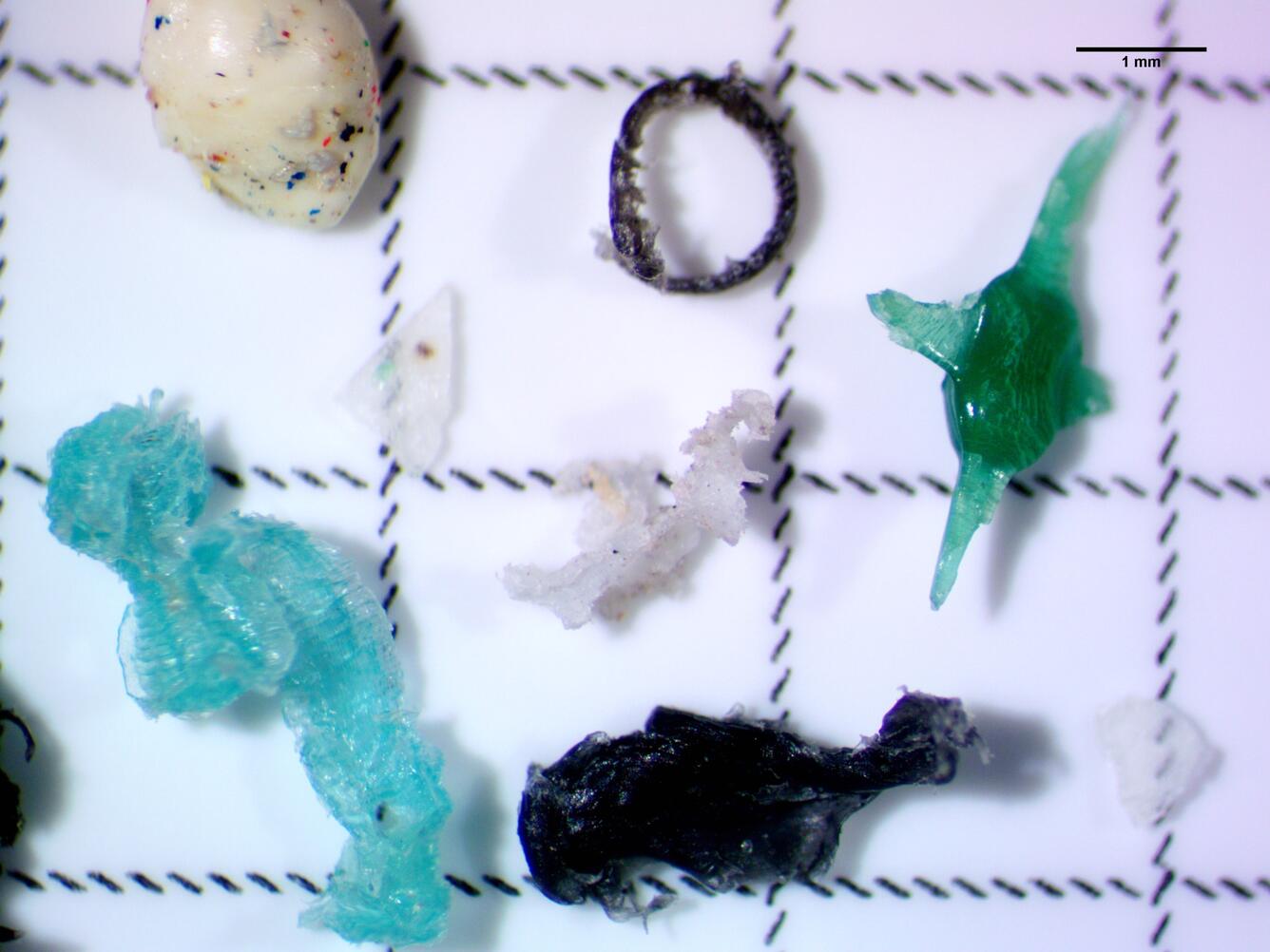
Featured image: microplastic fragments under a microscope, U.S. Geological Survey Environmental Health Program (USGS, public domain).