Physical Address
304 North Cardinal St.
Dorchester Center, MA 02124
Physical Address
304 North Cardinal St.
Dorchester Center, MA 02124

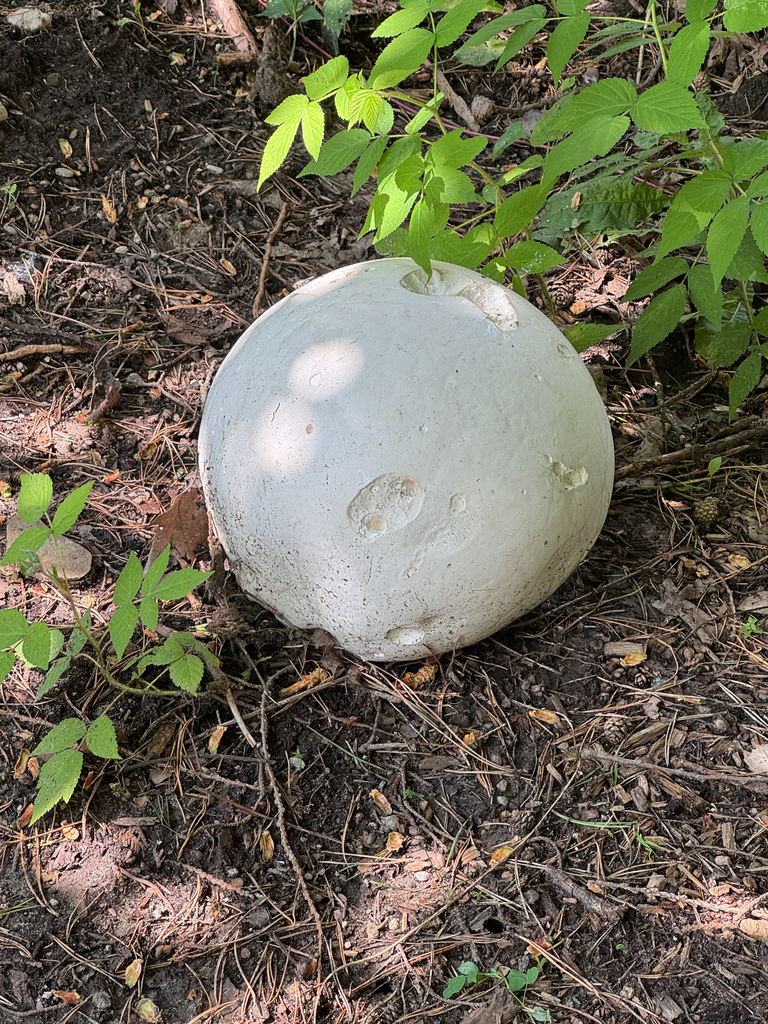
Young giant puffballs are a well-known edible, but poisonous earthballs and deadly young Amanitas can look similar. Learn the features to check and why you must always cut a puffball in half.
Puffballs are often described as one of the easier wild mushrooms to recognise. A big, white, round ball in a field is hard to miss, and young giant puffballs are a well-known edible. But “easy” doesn’t mean “safe”. Poisonous earthballs look like puffballs from a distance, and the deadly young stages of some white mushrooms can look like a puffball from the outside.
This guide explains what puffballs are, how they release their spores, which lookalikes to watch for, and the one check that experts say you should never skip.
A puffball is the fruiting body of a fungus that makes its spores inside a closed, rounded case rather than on gills. When the spores are mature, the case splits or opens and the spores escape as a cloud of “smoke”.
Iowa State University Extension and Outreach explains that puffballs, earthstars and earthballs are often grouped together as “gasteroid” fungi. It notes that this grouping is artificial: these fungi aren’t necessarily close relatives, and what they share is their rounded shape.
The University of Connecticut Extension says the common puffballs mostly belong to three genera: Calvatia, Calbovista and Lycoperdon.
The best-known puffball is the giant puffball, Calvatia gigantea. You’ll also see it listed as Langermannia gigantea and, according to the Australian National Botanic Gardens, Bovista gigantea.
| Feature | Giant puffball, according to the Missouri Department of Conservation |
|---|---|
| Size | 8 to 20 inches wide and tall. It can be “as big as a soccer ball or even much larger” and weigh 25 pounds or more |
| Outside | A round, smooth, soft white ball with a root-like attachment at the base. The skin cracks irregularly |
| Inside | “Pure white when fresh and young, yellowish green with age”, with a marshmallow-like texture |
| Season in Missouri | May to October |
| Habitat | Open pastures, woods and lawns, singly or in groups |
| Spore print | Greenish brown |
The University of Connecticut Extension says that in the northeastern United States, giant puffballs usually appear from August to September in disturbed sites with rich soil.
As a giant puffball ages, its white interior turns into a mass of spores. The numbers are huge. The Missouri Department of Conservation cites one mycologist’s estimate that a 15-inch puffball could hold “as many as seven trillion” spores. The University of Connecticut Extension gives a similar figure of up to 7 trillion spores for a puffball about 10 inches across. The two sources link the figure to different sizes, so treat it as a rough estimate.
The Australian National Botanic Gardens explains what happens next. As the outer skin ages, it cracks and flakes away, and the spores, held in a cotton-wool-like mass of threads, “are easily dispersed by the wind.”
Not all puffballs are giants. There are many smaller species, including those in the genus Lycoperdon. The University of Connecticut Extension describes the pear-shaped or stump puffball, Lycoperdon pyriforme, which grows on rotting wood rather than directly on the ground. It releases spores through a pore at the top, and wind and rain carry them away.
The same article notes that stepping on a mature puffball releases a cloud of spores, which doesn’t harm the fungus and helps spread the next generation.
There are two main groups of lookalikes, and both are why the “cut it in half” rule exists.
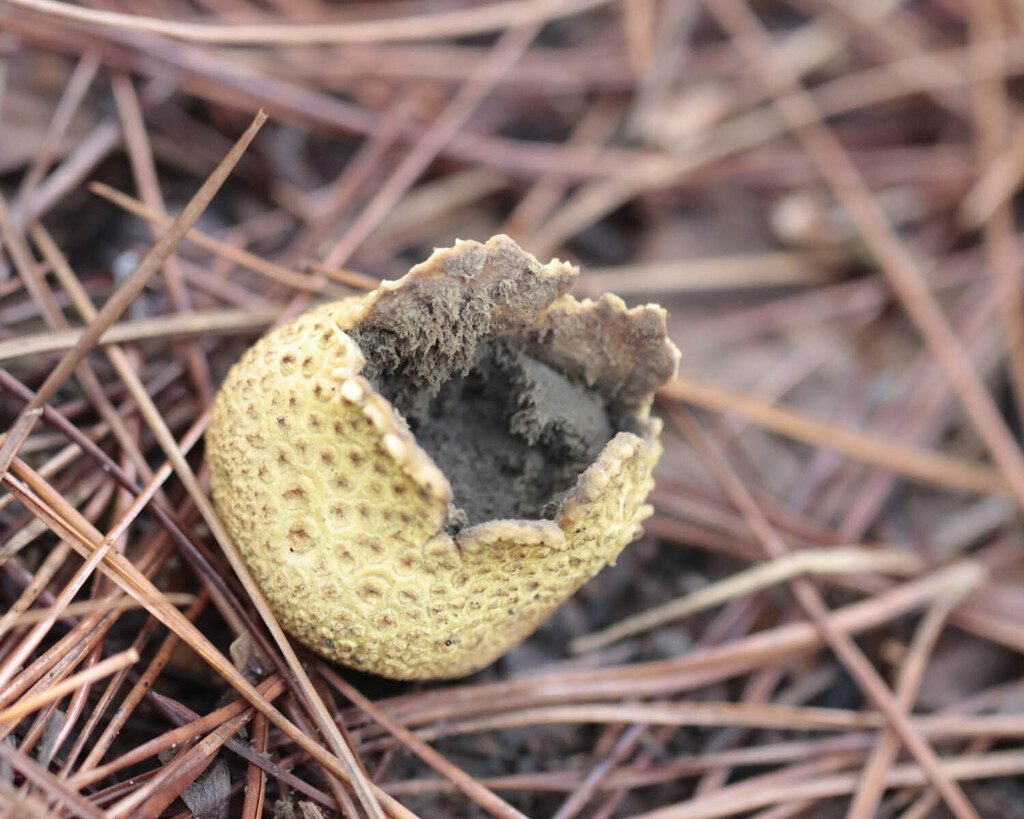
Earthballs belong to the genus Scleroderma. They are sometimes called hard puffballs, and the Missouri Department of Conservation calls the common earthball, Scleroderma citrinum, the pigskin puffball.
The Missouri Department of Conservation lists the common earthball as poisonous and says eating it can cause an upset stomach, nausea and vomiting. It adds that a close relative, the potato puffball (S. bovista), causes severe gastric upset. Iowa State University Extension notes that “some species are known to produce toxins.”
Here’s how earthballs differ from true puffballs, based on these sources:
| Feature | Common earthball (Scleroderma citrinum) | Young edible puffball |
|---|---|---|
| Skin | Thick, rind-like, yellowish brown and warty (Missouri) | Thin and soft. The giant puffball is smooth and white (Missouri) |
| Inside | Nearly white only when very young, then marbled, purplish and eventually blackish (Missouri) | Pure white and uniform when young (Missouri, UConn) |
| Size | About 1 to 4 inches wide (Missouri). Usually golf-ball sized, sometimes tennis-ball sized (Iowa State) | Varies. The giant puffball is far larger |
| Spore print | Blackish brown (Missouri) | Greenish brown in the giant puffball (Missouri) |
| Edibility | Poisonous | Edible only when young and pure white inside |
The Missouri Department of Conservation sums up the key difference: “Unlike edible puffballs, the pigskin puffball has a thick, rindlike skin.” It also notes that North America has about 20 Scleroderma species, which usually need a microscope to tell apart, so learning the group’s features matters more than knowing every species.
The more dangerous lookalike is a young gilled mushroom that hasn’t opened yet. Some mushrooms, including deadly Amanita species, begin life wrapped in a protective layer called a universal veil, which makes them look like a small white egg or ball.
The University of Connecticut Extension warns: “Some very poisonous white mushrooms resemble white puffballs when still inside their universal veil.” Iowa State University Extension makes the same point: “young deadly Amanita mushrooms look similar to puffballs from the outside.” The Missouri Department of Conservation names the destroying angel (Amanita bisporigera) as a white mushroom that has stages “in which they could be mistaken for a puffball.”
Our article on the death cap mushroom explains why Amanita poisoning is so serious.
The Missouri Department of Conservation and the Connecticut and Iowa State extension services all give the same advice: cut every puffball in half from top to bottom before eating.
According to the University of Connecticut Extension, once puffballs develop colour and produce spores, they become less tasty and can be toxic.
| What you see inside | What it means |
|---|---|
| Pure white, solid and uniform | Consistent with a young puffball, but still needs expert confirmation |
| The outline of a cap, gills or stem | Not a puffball. Possibly a deadly Amanita. Don’t eat |
| Purplish, grey or black, with a thick rind | Likely an earthball. Poisonous |
| Yellowish, greenish or brown, or powdery | An older puffball turning to spores. Don’t eat |
The Missouri Department of Conservation lists the giant puffball as a “choice edible, with caution” and gives these tips:
The University of Connecticut Extension adds the most important rule of all: “never eat mushrooms or fungi from the wild unless you are 200% sure you have identified it correctly.” In practice, that means having an experienced local expert check your find. Our review of mushroom identification apps explains why a phone app isn’t enough on its own.
If anyone feels unwell after eating a wild mushroom, get medical help straight away. Our guide to mushroom poisoning symptoms explains what to do. If a pet may have eaten a wild mushroom, contact your vet.
Puffballs and earthballs often turn up in lawns. Iowa State University Extension describes them as a nuisance in well-kept lawns. Earthballs form just under the soil surface, and as they mature they can leave depressions that make a lawn bumpy.
Iowa State University Extension says there’s no practical way to control them other than removing the fruiting bodies as they appear. The fungus itself lives on underground, so they may well come back. Puffballs can also form fairy rings, which our separate guide covers in detail.
Spore print colour is one of the features that separates earthballs from giant puffballs: blackish brown for the common earthball and greenish brown for the giant puffball, according to the Missouri Department of Conservation. Our step-by-step guide to making a spore print covers the method for gilled mushrooms.
Young giant puffballs are a well-known edible, but two kinds of lookalike make care essential. Earthballs have a thick, warty rind and a dark interior, and they are poisonous. Young deadly mushrooms, including Amanita species, can look like small white puffballs from the outside. Always cut every puffball in half from top to bottom, eat only those that are pure white and uniform inside with no outline of a cap or gills, and have an expert confirm your identification before you eat anything.
Featured image: giant puffball by adamcvean via iNaturalist (CC0 1.0).