Physical Address
304 North Cardinal St.
Dorchester Center, MA 02124
Physical Address
304 North Cardinal St.
Dorchester Center, MA 02124

Mycoremediation uses fungi to break down or capture pollutants such as oil, pesticides and metals. Here's how it works, what lab and field studies show, and where the hype runs ahead of the science.
Fungi are nature’s great recyclers. They break down wood, leaves and other tough materials that most living things can’t digest. So it’s no surprise that people have asked: could fungi also break down oil spills, pesticides and other pollution? That idea is called mycoremediation, and it has gone from a niche topic to a popular one, with community projects, start-ups and plenty of hopeful headlines.
This article looks at how mycoremediation is supposed to work, what the evidence shows so far, and where the hype runs ahead of the science.
Mycoremediation means using fungi to remove, break down or contain pollutants in soil or water. It’s a type of bioremediation, the wider practice of using living things, such as bacteria and plants, to clean up contamination.
The idea is appealing because the main alternative for contaminated soil is often to dig it up and take it somewhere else. Danielle Stevenson, an environmental scientist at the University of California, Riverside, who has run field trials of fungi on polluted land, contrasts bioremediation with that approach and argues that it “can be much more cost-effective than traditional techniques”. That is a claim still being tested.
Fungi use two main tools, according to a review of mycoremediation by Akpasi and colleagues in the journal Applied Sciences.
Fungi digest their food outside their bodies by releasing enzymes. Wood-rotting fungi, in particular, produce powerful “ligninolytic enzymes such as laccases, lignin peroxidases, and manganese peroxidases” that evolved to break down lignin, one of the toughest substances in wood. The review describes these extracellular enzymes, along with other enzyme systems, as the main way fungi detoxify and transform organic pollutants.
Metals can’t be broken down, but they can be captured. The review explains that fungal cell walls bind metals through chemical groups such as amines and carboxylates. This doesn’t destroy the metal, but it can concentrate it in the fungus.
| Pollutant group | Examples listed in the Akpasi review | Main fungal mechanism |
|---|---|---|
| Petroleum hydrocarbons | Oil and fuel residues | Enzyme breakdown |
| Persistent organic pollutants | Polycyclic aromatic hydrocarbons (PAHs), pesticides, industrial dyes | Enzyme breakdown |
| Emerging contaminants | Pharmaceuticals, phthalates | Enzyme breakdown |
| Heavy metals | Cadmium, lead, mercury | Biosorption (binding) |
Much of the research on mycoremediation has been carried out in laboratories, where conditions are controlled. A 2019 review in Environmental Science: Processes and Impacts by Dickson and colleagues looked at fungi and petroleum-contaminated soils. It found that despite decades of study, “there seems to be little progress on its commercial application to petroleum-contaminated soils.” The authors called for methods “that can easily translate laboratory results to field applications”.
The Akpasi review makes the same point, describing the challenge of “scaling up laboratory successes to real-world applications.”
Real-world trials are rarer but growing. A 2024 project summary from the Center for Creative Land Recycling describes field trials led by Danielle Stevenson at three brownfield sites in Los Angeles, contaminated with fuels, solvents, PAHs and metals such as lead and arsenic.
| Approach | Reported result (CCLR summary) |
|---|---|
| Decomposer fungi on diesel, gasoline and PAHs | “more than 50% removal in 3 months” |
| Native plants that take up metals, with mycorrhizal fungi | “Small but statistically significant reductions in soil metals” in treated plots compared with untreated control plots |
The summary describes these as “among very few field tests of mycoremediation in the United States”. They’re encouraging, but they’re one programme, and the authors call for more field studies and larger pilots. Mycorrhizal fungi, which partner with plant roots, are explained in our article on the “wood wide web”.
After the October 2017 wildfires in Northern California, volunteers with the Fire Remediation Action Coalition placed more than 40 miles of straw wattles inoculated with oyster mushroom spawn around roads, car parks and hillsides, according to a 2019 report in The Counter. The aim was to slow runoff and let the fungi break down contaminants.
It was an inspiring community effort, but it wasn’t designed as a scientific study. The project’s own progress report, as described by The Counter, said there were no control areas, no measurements of toxin levels before treatment and no standard amount of mycelium in each wattle. So we don’t know how much difference the fungi made. A mushroom cultivation teacher quoted in the article put it simply: “we don’t yet know the speed of the breakdown, and how effective that breakdown is.”
According to the Akpasi review, fungi have been applied in oil spill clean-up, wastewater treatment and agricultural waste management. These are settings where a slow, low-cost biological process can be useful alongside other methods, rather than replacing them.
| Method | How it works | Points to consider |
|---|---|---|
| Dig and dispose | Contaminated soil is excavated and taken elsewhere | The conventional approach that Stevenson contrasts with bioremediation. It moves the problem rather than treating it on site |
| Phytoremediation (plants) | Plants take up or stabilise pollutants, especially metals | The CCLR summary notes that metal-loaded plants may need to be treated as hazardous waste |
| Mycoremediation (fungi) | Fungal enzymes break down organic pollutants, and fungi bind some metals | Field evidence is limited, and results depend on the fungus, pollutant and site |
| Combined approaches | Fungi, plants and bacteria used together | The Los Angeles trials found mycorrhizal fungi enhanced the plants’ performance, and the Akpasi review suggests combining fungi with bacterial degradation |
| Challenge | Why it matters |
|---|---|
| Lab results don’t always transfer | Soil, weather and mixed pollutants are far more complicated outside the lab (Dickson et al.; Akpasi et al.) |
| Conditions affect fungi | The Akpasi review notes that pH, temperature and other contaminants can reduce how well fungi work |
| Fungi grow slowly | Keeping healthy fungal populations at a contaminated site over time is difficult (Akpasi et al.) |
| Each site is different | Dickson and colleagues say site conditions must be built in from the start. Treatments need matching to the fungus, pollutant and location |
| Speed and regulation | According to The Counter, clean-up rules often demand removal within tight timeframes, which slow biological methods may struggle to meet at industrial scale |
| Funding | A microbiologist quoted by The Counter said the field has struggled to attract investment |
| Contaminated by-products | Plants and mushrooms that absorb metals may need to be treated as hazardous waste |
The reviews agree on what the field needs. The Akpasi review lists:
The CCLR summary adds that the next step for the Los Angeles work is more field studies and pilot projects, testing the best plant and fungus combinations under different conditions and at larger scales. In other words, the science is moving from “can fungi do this?” to “how well, how fast and where?”
This is the most important safety point. Because fungi can soak up metals and other pollutants, mushrooms that grow during a clean-up project are not food. The CCLR summary states that mushrooms that form should not be eaten and must be disposed of properly. It suggests that working with mycelium rather than mushrooms can help avoid this by-product.
The same caution applies at home. If you forage, avoid picking mushrooms from roadsides, industrial land or other places that might be polluted. NAMA also notes that mushrooms from lawns, roadsides or industrial areas could carry pesticides or heavy metals. Our guide to wild vs cultivated mushrooms has more on choosing safe sources.
Small-scale experiments, such as straw wattles inoculated with oyster mushroom spawn, are popular with gardeners and community groups. Oyster mushrooms are easy to grow, as our oyster mushroom guide explains. But keep expectations realistic:
Fungi are also being explored for other environmental jobs, such as making packaging and insulation from farm waste. Our article on mycelium materials covers that story.
Fungi really can break down or capture some pollutants, thanks to their powerful enzymes and metal-binding cell walls. Lab studies are promising, and a small number of field trials show measurable results. But mycoremediation is not yet a proven, large-scale replacement for conventional clean-up. The field needs more well-designed field studies, and anything that grows on contaminated ground should never be eaten.
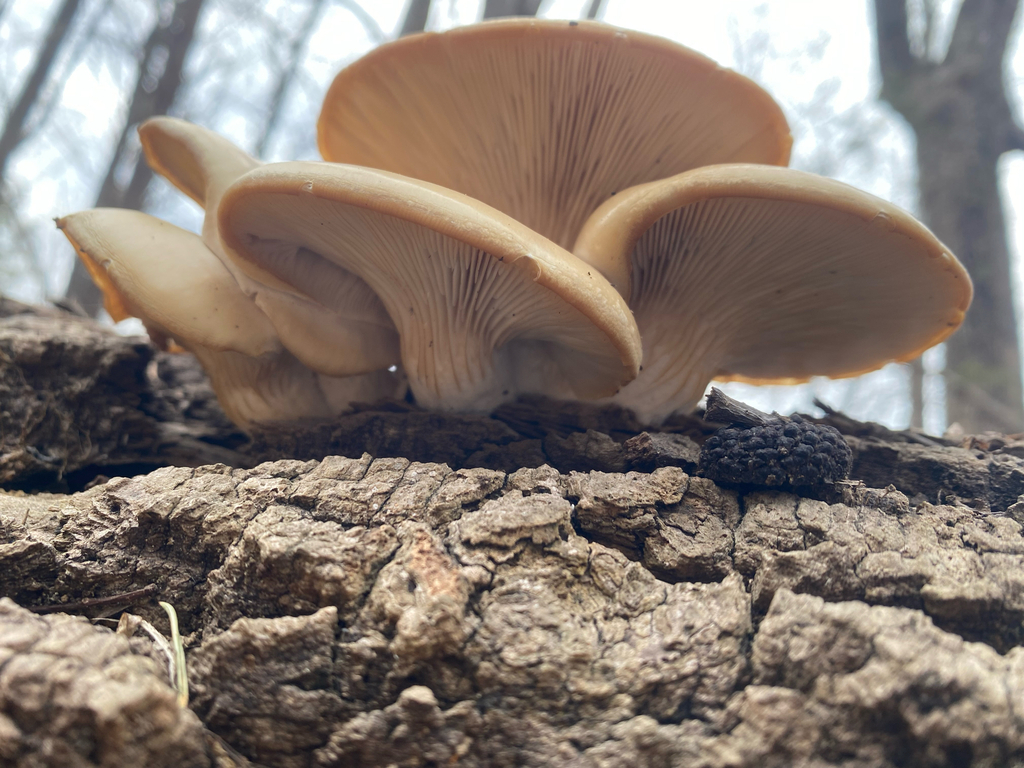
Featured image: oyster mushrooms on a log by Kirstie S via iNaturalist (CC0 1.0).


[…] the toughest materials in wood, using enzymes they release into their surroundings. Our article on mycoremediation explains how those same enzymes are being tested against oil, pesticides and other pollutants. […]