Physical Address
304 North Cardinal St.
Dorchester Center, MA 02124
Physical Address
304 North Cardinal St.
Dorchester Center, MA 02124

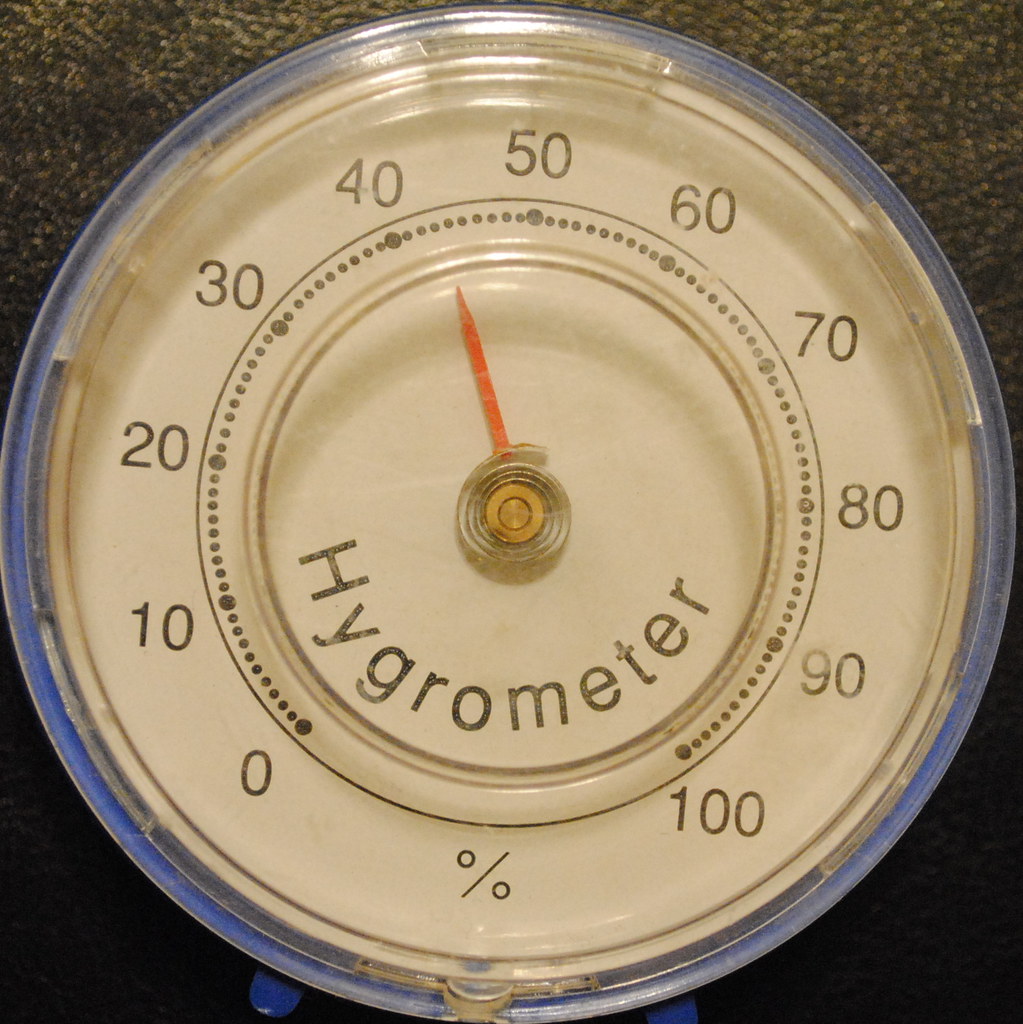
Cheap hygrometers often struggle at the high humidity mushrooms need. Here's how to choose one, where to put it, and how to check it at home with table salt.
Humidity is one of the three things that make or break a mushroom harvest, alongside fresh air and light. Too dry, and pins can stall or caps can crack. Too wet, and surfaces stay soggy. To manage humidity, you need to measure it, and that means a hygrometer.
The problem is that cheap hygrometers can be surprisingly inaccurate, and mushroom growing pushes them to the top of their range, where they struggle most. This guide explains the different types, what accuracy you can expect, where to put one, and how to check it at home with nothing more than table salt.
For the bigger picture on why humidity matters, see our guide to humidity, fresh air and light.
Most hygrometers show relative humidity (RH). That is the amount of water vapour in the air, as a percentage of the most the air could hold at that temperature. Because warm air can hold more water than cool air, RH changes with temperature even when the amount of water stays the same. That’s why most hygrometers also show temperature, and why the two readings belong together.
Targets vary by species and stage, and you should follow your spawn supplier’s figures first. Two examples from sources we’ve used in our growing guides show the range:
| Species and stage | Humidity target | Source |
|---|---|---|
| Golden enoki, while pins form | 98 to 100% | North Spore |
| Golden enoki, as mushrooms develop | 88 to 95% | North Spore |
| Wood ear (Auricularia cornea), fruiting | 75 to 85% | Walker et al. 2023 |
Many fruiting targets sit near the top of the scale. That matters, because it is exactly where many hygrometers are least reliable. You can read more in our guides to growing enoki and growing wood ear.
A University of Kentucky Cooperative Extension publication, Measuring Relative Humidity in Agricultural Environments, compares the main options for farms and greenhouses. The same tools are used by mushroom growers.
| Type | How it works | Typical accuracy and cost (University of Kentucky, 2005) | Pros and cons |
|---|---|---|---|
| Digital hygrometer | An electronic sensor with a display | About ±5% RH, “the norm for low-cost devices”. About $25 to $40 | Cheap and easy to read. Accuracy can fade |
| Dial hygrometer | A mechanical dial | Similar accuracy to a basic digital unit. Up to $85 | No battery, but can’t record readings |
| Sling psychrometer | Two thermometers, one with a wet wick, spun through the air | Read from charts using the two temperatures. About $45 to $70 | No electronics to drift, but slow and manual |
| Data logger | An electronic sensor that records readings over time | Some rated at ±2% RH. About $129 to $249 | Shows what happens overnight and over days |
Prices date from 2005, so treat them as a rough guide to the relative cost rather than current prices.
For most people, a digital hygrometer that also shows temperature is the practical choice. If you want to know what your fruiting chamber does while you’re asleep, a data logger is worth the extra cost. Whatever you buy, assume it needs checking.
A psychrometer is worth knowing about because it has no electronic sensor to drift. The University of Kentucky describes how to use one:
Keep the wick clean and wet before every reading. A psychrometer is awkward to use inside a small fruiting tent, but it makes a handy cross-check for an electronic hygrometer in a larger grow room.
The University of Kentucky publication warns that new devices may be accurate to ±2 to 5% RH, but that dust, moisture, fog and gases can degrade the sensors. It adds that cheaper devices often lose accuracy within six months to a year if used carelessly. It also advises avoiding sustained humidity above 95% and nighttime fog where possible, because both seriously affect accuracy.
That is a challenge for mushroom growers, who often run chambers in the high 90s. A field test of electronic humidity sensors by K. C. Wong of the Meteorological Service of Canada shows what can happen. After long periods of saturation, the sensors were slow to recover once the air became drier, by around 40 to 90 minutes on average depending on the model. The author suggests this was likely because condensation had formed on the sensor and had to dry off first. In a misted fruiting chamber, a hygrometer that has been soaked may read “100%” for a while after the air has dried.
The University of Kentucky gives some placement rules for farm and greenhouse use that translate well to a grow space:
Place the sensor at the height of your mushrooms, not at the top of the chamber. Our guide to building a simple fruiting chamber covers chamber design.
You can check a hygrometer at home using a saturated salt solution. It works because a sealed space above a saturated solution of a given salt settles at a known humidity. The reference values come from a 1977 paper by Lewis Greenspan at the US National Bureau of Standards (now NIST), which is still widely cited.
| Salt | Relative humidity at 20°C (Greenspan 1977) |
|---|---|
| Magnesium chloride | About 33% |
| Sodium chloride (table salt) | About 75.5% |
| Potassium chloride | About 85% |
| Potassium sulphate | About 97.6% |
Sodium chloride is the easy one, because it’s in every kitchen. Greenspan’s data also show that its value barely changes with temperature, staying close to 75% between 10°C and 40°C.
A hygrometer is a guide, not a target to hit to the decimal point. Mushrooms will also tell you what they need. Dry, cracked caps and stalled pins suggest the air is too dry. Wet, slimy surfaces suggest it is too wet or too still. If your mushrooms aren’t fruiting at all, our fruiting troubleshooting guide works through the other usual suspects.
Featured image: hygrometer by Sally E J Hunter via Flickr (CC BY 2.0).